 BTC
 ETH
 SOL
 XRP
 BNB
 DOGE
 ADA
 AVAX
 LINK
 TON
 DOT
 LTC
 TRX
 POL
 USDT
 USDC
 SUI
 HBAR
 SHIB
 BCH
 XLM
 NEAR
 APT
 ARB
Coinbase took 80% of last week's Bitcoin spot selling, DWF Labs says
DWF Labs said $634m, or 80% of Bitcoin's net spot selling last week, ran through Coinbase, pointing to US institutional or ETF-related pressure. OKX was the only net buyer.
Why it matters: It suggests US institutional or ETF money, not Asian retail, drove last week's Bitcoin selling pressure.

Reviewed and fact-checked by Jayshree Majumdar on 16 Nov 2026

In short
- DWF Labs says Coinbase accounted for $634m, or 80%, of Bitcoin's net spot selling in the week to 15 November.
- Binance saw $265m of net spot selling and OKX was the only net buyer at $118m, according to the firm.
- The company reads the Coinbase concentration as likely US institutional or ETF-related selling, and puts support at $58,000-$62,000.
- US spot Bitcoin ETFs lost $1.07bn in the 9-13 November week, a third straight week of outflows, per SoSoValue.
Coinbase's $634m spot selling
On 16 November 2026, DWF Labs said Coinbase accounted for $634m, or 80%, of Bitcoin's total net spot selling last week. OKX was the only major exchange to record net spot buying, at $118m, while Binance posted about $265m of net selling, according to the crypto market maker. At the time of writing (11:50 UTC on 16 November 2026), Bitcoin (BTC) traded at $63,947, down 2.16% in 24 hours, with a market value of $1.29tn, according to InvestIn.News market data.
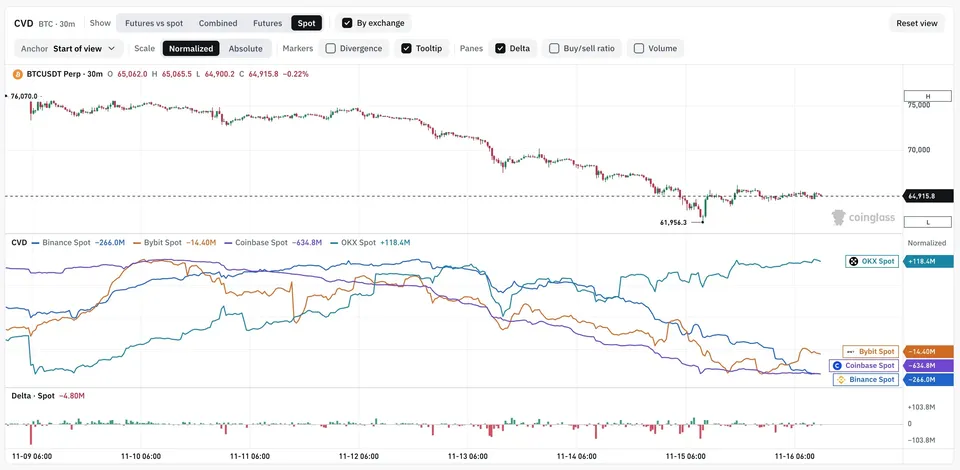
The company, publisher of the weekly 'Eyes on the Market' report, said the large Coinbase share suggests selling led by American institutions or funds linked to spot ETFs. Coinbase's trading is mainly institutional, and it is a major custodian for spot Bitcoin ETFs in the US, so its spot activity is more likely to show institutional selling than Asian retail flows. The report said the pattern fits active selling through US institutional channels or ETF-related money better than offshore retail or Asia-led selling.
Is US institutional or ETF money really leading the sell-off?
The figures come from spot cumulative volume delta, or CVD, which subtracts taker buys from taker sells. A negative reading means sell-side trades outweighed buy-side trades. TokenPost noted that CVD does not identify who placed the orders or prove that Coinbase itself sold assets. During the 9-13 November trading week, spot Bitcoin ETFs recorded $1.07bn in net outflows, their third consecutive week of withdrawals, PANews reported, citing SoSoValue. BlackRock's IBIT made up $909m of that total. The firm had linked the spot weakness to US institutional or ETF-related selling.
The report added that Bitcoin closed below its 200-week moving average at about $68,000 for the first time since mid-August, and it put the next support zone at $58,000 to $62,000, around the lows seen last summer. The company expects high volatility and choppy price action until the market absorbs the latest decline.
How Bitcoin traders reacted on X
- 发财姐 (@lianshangbiji) said on X that OKX's positive CVD should not be read as accumulation. With Coinbase institutions net selling $634m, retail traders were catching a knife from large US money, and she was not adding until institutional CVD turned positive, translated from Chinese.
- WW (@kingli560043) said on X that November is the season for US year-end tax-loss harvesting, so heavy Coinbase selling is not necessarily bearish and may reflect tax-loss selling, translated from Chinese.
OKX那1.18亿正CVD别急着当吸筹看,Coinbase那边机构净卖6.34亿,占了八成,等于散户在接美国大资金的刀,这种结构抢反弹容易挨埋。我那点仓先不加,等机构这边CVD转正再说。
 发财姐 @lianshangbiji · · View on X
十一月正好是美国人年底割肉抵税的季节,Coinbase那边卖得凶,不一定全是看空,可能有不少是税务亏损收割🤔
 WW @kingli560043 · · View on X
What the Coinbase selling means for Bitcoin traders
For Bitcoin traders, the key caution is that a negative spot CVD on Coinbase does not reveal who sold or guarantee further declines. TokenPost said the venue-level metric cannot identify the seller. DWF Labs has flagged $58,000 to $62,000 as the next support zone, but the report does not say the price will stop there, and traders can watch whether institutional CVD turns positive before assuming the selling is done.
Key numbers
| What | Figure |
|---|---|
| Coinbase spot CVD last week | $634m |
| Binance spot CVD last week | $265m |
| OKX spot CVD last week | +$118m |
Timeline
- 13 Nov 2026: US spot Bitcoin ETFs lost $1.07bn, third straight outflow week
- 15 Nov 2026: Bitcoin closed below 200-week moving average at about $68,000
- 16 Nov 2026: the weekly report names Coinbase spot CVD at -$634m
Questions readers ask
What is causing the Bitcoin sell-off in November 2026?
The company says Coinbase accounted for $634m, or 80%, of Bitcoin's net spot selling last week, suggesting US institutional or ETF-related flows led the pressure. Bitcoin also closed below its 200-week moving average at about $68,000, with support at $58,000 to $62,000, according to the report.
What is the latest news on US spot Bitcoin ETF outflows?
Spot Bitcoin ETFs lost $1.07bn in the 9-13 November trading week, a third consecutive week of outflows, according to SoSoValue data reported by PANews. BlackRock's IBIT accounted for $909m of that total.
Is Coinbase itself selling Bitcoin?
No, the data does not show that. TokenPost noted that spot cumulative volume delta, which DWF Labs used, shows seller-initiated trade exceeded buyer-initiated trade on the venue. It cannot identify who placed the orders or prove that Coinbase itself sold assets.
Our view
At InvestIn.News, we think the firm's conclusion that US institutional or ETF-related money led last week's Bitcoin selling is directionally right, but it should not be read as proof that only US institutions sold.
The Coinbase concentration is meaningful: Coinbase is the main custodian for US spot Bitcoin ETFs and its spot market is largely institutional, so a negative spot CVD of $634m is more consistent with large US sellers than with Asian retail. That is the part of DWF's argument we find convincing.
But the venue-level metric cannot identify who sold, as TokenPost noted, and heavy Coinbase selling in November can also reflect year-end tax-loss harvesting rather than outright bearishness. Spot Bitcoin ETF outflows of $1.07bn support the idea of US investor pullback, yet Binance's $265m of selling and OKX's $118m of buying show the flow was not uniform across venues.
We will treat the institutional-seller story as confirmed only when fund-level data or named counterparties show who actually sold, and until then we see DWF's reading as a useful, but incomplete, map of the selling.
How we reported this: this story draws on reporting by tokenpost.com and PANews, 2 public posts shown in the story and InvestIn.News market data. Each source is linked in the text and listed under Sources.
Follow the latest as it happens on ETFs NewsFeeds.
What to watch: DWF Labs expects volatility to remain high until the market absorbs the latest decline, with support at $58,000 to $62,000.
Sources
- tokenpost.com: Coinbase Spot CVD Reached About Negative $634 Million Through Nov. 15 | TokenPost
- PANews: Bitcoin spot ETFs bleed $1.07bn in third straight week of outflows
- 发财姐 (@lianshangbiji): Post
- WW (@kingli560043): Post
- BlockBeats: DWF: 80% of last week's spot net selling came from Coinbase, with selling pressure likely mainly originating from US institutions.
- ChainCatcher: DWF: Last week, 80% of the net spot sales cam...
- X: X 上的 DWF Labs:“Eyes on the Market: Extreme Fear” / X
- WEEX: DWF: Last Week Coinbase Spot Net Sales Accounted for 80% | WEEX Crypto News
- cobak.co: 80% of Weekly Net Spot Selling Occurred at Coinbase ($COIN) | Crypt...
- netdania.com: Coinbase Was the Site of Nearly All Weekend Bitcoin (BTC) Sales, Flood Says
- U.Today: Crypto Traders Blame Binance for Bitcoin Drop, But Data Points to Coinbase - U.Today
- InvestIn.News market data
Live updates on NewsFeeds:BitcoinBy Keshav Aggarwal
Disclosure: Keshav Aggarwal holds small amounts of crypto as long-term investments. He does not trade any asset he writes about within 24 hours of a story, and is not paid by any company covered on this site, updated 6 October 2026. Our holdings and trading policy.
How this was produced: the writer drafted this piece with AI help, from the reporting and sources it names, then checked and edited it. Read our Editorial and AI policy. Spotted a mistake? See Corrections.
Not investment advice. Read the risk disclaimer.