 BTC
 ETH
 SOL
 XRP
 BNB
 DOGE
 ADA
 AVAX
 LINK
 TON
 DOT
 LTC
 TRX
 POL
 USDT
 USDC
 SUI
 HBAR
 SHIB
 BCH
 XLM
 NEAR
 APT
 ARB
Bitcoin mining difficulty falls 9.13% in largest drop since June
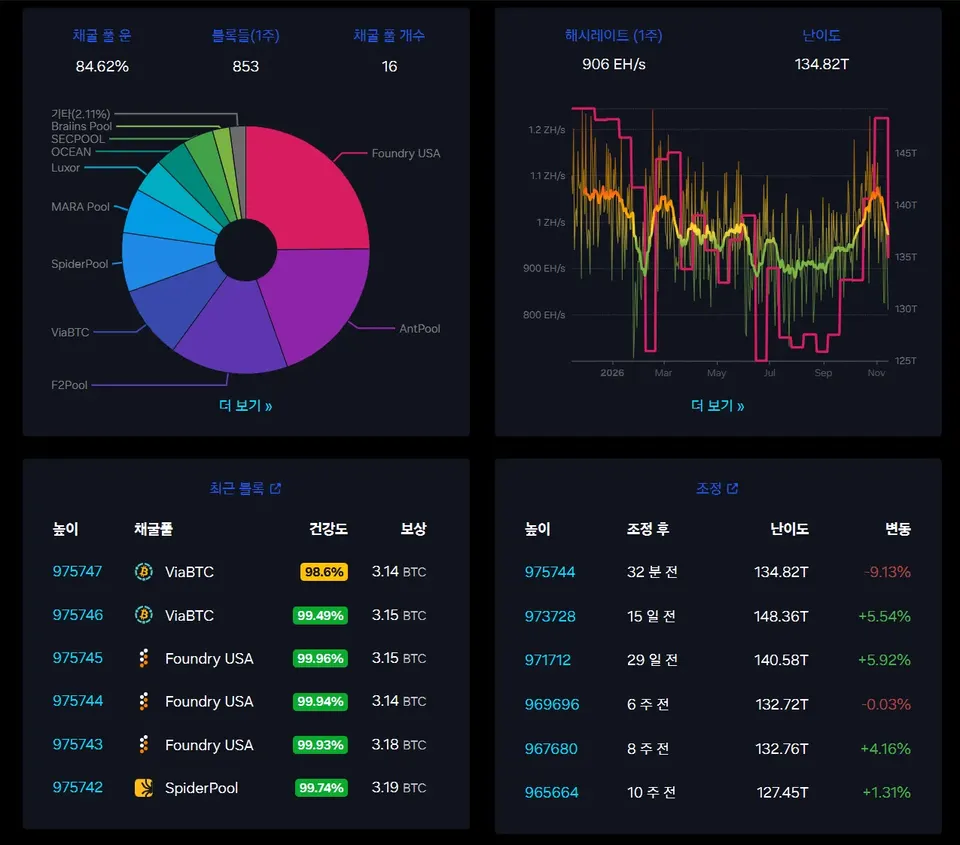
The network's difficulty fell to 134.82 trillion at block 975,744, giving remaining miners slightly more reward per hash as weak miners switched off.
Why it matters: The drop shows Bitcoin's mining network rebalancing after weak miners shut down, changing revenue for the miners still online.

Reviewed by Ishu Aggarwal on 15 Nov 2026

In short
- Bitcoin mining difficulty fell 9.13% to 134.82 trillion at block height 975,744 on 14 November 2026.
- It was the biggest single drop since the 10.09% cut on 14 June, according to Mempool and Odaily.
- Miners still running can earn slightly more for the same hashrate, InvestIn.News calculated.
- Bitcoin traded at $67,105, down 3.04% in 24 hours, at 12:45 UTC, according to InvestIn.News market data.
Bitcoin's mining difficulty dropped 9.13% on 14 November 2026, falling to 134.82 trillion at block height 975,744, the largest single decline since a 10.09% cut on 14 June, according to Bitcoin explorer Mempool and Odaily. The drop leaves miners still running their rigs able to earn a little more Bitcoin for the same computing power, InvestIn.News calculated. At the time of writing (12:45 UTC on 14 November 2026), Bitcoin traded at $67,105, down 3.04% in 24 hours, with a market value of $1.35tn, according to InvestIn.News market data.
What is Bitcoin mining difficulty?
Mining difficulty measures how hard it is to find a new block on the Bitcoin network. The protocol adjusts it roughly every two weeks to keep block times near 10 minutes, TradingView explained. Before this drop, difficulty had risen 5.92% on 16 October and 5.54% on 29 October to 148.36T, according to Odaily and PANews. The 14 June decline took difficulty from 138.96T to 124.93T, TokenPost reported.
What the difficulty drop means for Bitcoin miners
The 9.13% decline makes mining a little easier for the rigs still online: the same hashrate now competes against fewer machines, so each one can expect slightly more Bitcoin. InvestIn.News calculated the change offers some breathing room to miners who stayed on through Bitcoin's price slide and high difficulty. The Defiant calculated that the cut raises expected gross revenue per unit of computing power by about 10%, holding Bitcoin's price, the block subsidy and average transaction fees per block constant. Weaker miners likely switched off their rigs, and that is exactly what pushes difficulty down.
Why did hashrate fall in November 2026?
Bitcoin's hashrate, the total computing power securing the network, dropped because weaker miners turned off their machines, according to The Defiant and Phemex. Phemex noted block times slowed to about 11 minutes, well above the network's 10-minute target, before the adjustment. Bitcoin's price slide squeezed miners, and the two prior difficulty rises left less room for older, less efficient rigs to run profitably.
How X users reacted to the difficulty cut
- Cointelegraph (@Cointelegraph) said on X the drop was the biggest cut since June and that miners finally get to breathe.
- Prince (@princexsol) said on X the decline shows weak miners already capitulated, which he called closer to the end of the pain than the start.
- SHADY 🐐 (@rubencsq) said on X that basically a lot of rigs were turned off.
- Niels (@Web3Niels) said on X a little breathing room never hurts.
- Mari (@Maribtxn) said on X a 9% difficulty cut is big and that miners have been bleeding, hoping it holds them over.
🔥 BIG: Bitcoin mining difficulty just dropped 9.13% to 134.82T, the biggest cut since June.
Miners finally get to breathe. pic.twitter.com/Ec7hb9Nd6g
 Cointelegraph @Cointelegraph · · View on X
Biggest difficulty drop since June tells you the weak miners already capitulated. That's usually closer to the end of the pain than the start.
 Prince @princexsol · · View on X
Basically a lot of rigs were turned off
 SHADY 🐐 @rubencsq · · View on X
a little breathing room never hurts
 Niels @Web3Niels · · View on X
9% difficulty cut is big tho… miners been bleeding, hope it holds them over
 Mari @Maribtxn · · View on X
Key numbers
| What | Figure |
|---|---|
| Difficulty before adjustment | 148.36 T |
| Difficulty after adjustment | 134.82 T |
| Single decline | 9.13% |
| Previous rise on 16 October | 5.92% |
| Previous rise on 29 October | 5.54% |
Timeline
- 16 Oct 2026: Difficulty rose 5.92%
- 29 Oct 2026: Difficulty rose 5.54% to 148.36T
- 14 Nov 2026: Difficulty dropped 9.13% to 134.82T
Questions readers ask
What is Bitcoin mining difficulty?
Bitcoin mining difficulty measures how hard it is to find a new block on the Bitcoin network. The protocol adjusts it roughly every two weeks to keep block times near 10 minutes, TradingView explained. It changes according to shifts in the network's total computing power, or hashrate.
How much did Bitcoin mining difficulty drop on 14 November 2026?
Bitcoin mining difficulty fell 9.13% at block height 975,744, from 148.36T to 134.82T, according to Mempool and Odaily. It was the biggest single decline since the 10.09% cut on 14 June.
What does the Bitcoin mining difficulty drop mean for miners?
The drop makes mining a little easier for rigs still online, because the same hashrate now competes against fewer machines and can expect slightly more Bitcoin reward. InvestIn.News calculated the change offers breathing room to miners who stayed on through Bitcoin's price slide and high difficulty.
When is the next Bitcoin mining difficulty adjustment?
Bitcoin adjusts mining difficulty roughly every two weeks, so the next adjustment is due about two weeks after 14 November 2026. No exact date was given in the reports, but the adjustment will show whether the network's hashrate has stabilised.
Our view
At InvestIn.News, we think the 9.13% difficulty drop offers genuine relief, but narrowly, to the miners still running efficient rigs. The adjustment is the network's way of rebalancing after a wave of weaker machines switched off.
The two prior rises, 5.92% on 16 October and 5.54% on 29 October, had lifted difficulty to 148.36T, while Bitcoin's price slid to $67,105 on 14 November. That combination made older hardware uneconomical, and the slower 11-minute block times recorded by Phemex confirm the hashrate contraction.
The next difficulty adjustment will show whether the hashrate has stabilised, a key signal to watch for whether the remaining miners can keep the network running profitably.
How we reported this: this story draws on reporting by The Defiant, Odaily, TradingView, Phemex and tokenpost.com and 1 more, 5 public posts shown in the story, InvestIn.News market data and first-hand reporting by our writer. Each source is linked in the text and listed under Sources.
Follow the latest short updates on Mining NewsFeeds.
What to watch: The next difficulty adjustment, due in roughly two weeks, will show whether the network's hashrate has stabilised.
Sources
- The Defiant: Bitcoin Mining Difficulty Falls 9.1%, Most Since June | The Defiant
- Odaily: Bitcoin mining difficulty drops 9.13% to 134.82 T, the largest decline since June
- TradingView: Bitcoin Mining Difficulty Falls 9.13%, Biggest Drop Since June
- Phemex: Bitcoin Mining Difficulty Drops 9.13%, Biggest Cut Since Jun | Phemex News
- tokenpost.com: Bitcoin Mining Difficulty Drops 9.13%, Biggest Cut Since June | TokenPost
- PANews: Bitcoin mining difficulty falls 9.13% to 134.82 T, largest drop since June
- Cointelegraph (@Cointelegraph): Post
- Prince (@princexsol): Post
- SHADY 🐐 (@rubencsq): Post
- Niels (@Web3Niels): Post
- Mari (@Maribtxn): Post
- news.futunn.com: Bitcoin mining difficulty decreased by 9.13% to 134.82 T, marking the largest drop since June.
- Coinlive: Bitcoin Mining Difficulty Falls 9.13% to 134.82 T, Biggest Drop Since June
- InvestIn.News market data
Live updates on NewsFeeds:BitcoinMiningBy Keshav Aggarwal
Disclosure: Keshav Aggarwal holds small amounts of crypto as long-term investments. He does not trade any asset he writes about within 24 hours of a story, and is not paid by any company covered on this site, updated 6 October 2026. Our holdings and trading policy.
How this was produced: the writer drafted this piece with AI help, from the reporting and sources it names, then checked and edited it. Read our Editorial and AI policy. Spotted a mistake? See Corrections.
Not investment advice. Read the risk disclaimer.