 BTC
 ETH
 SOL
 XRP
 BNB
 DOGE
 ADA
 AVAX
 LINK
 TON
 DOT
 LTC
 TRX
 POL
 USDT
 USDC
 SUI
 HBAR
 SHIB
 BCH
 XLM
 NEAR
 APT
 ARB
DefiLlama: 71% of 558 blockchains earned zero fees in 24 hours
Of 558 chains tracked on 3 October 2026, 399 collected nothing and only seven cleared $100,000, led by Solana at $1.09m. Fees measure usage, not importance.
Why it matters: The fee table is one of the few concrete signals of real usage in crypto, showing which networks people actually pay to use rather than simply hold tokens on.

Reviewed by Jayshree MajumdarFact-checked by Keshav Aggarwal
In short
- DefiLlama tracked 558 blockchains on 3 October 2026; 399 of them, or 71%, earned $0 in 24-hour fees.
- 443 chains collected under $10 and 514 collected under $1,000 in the same window.
- Only seven chains cleared $100,000, led by Solana at $1.09m and Tron at $922,900.
- Fees measure what users paid to transact, not a chain's overall importance.
Most blockchains are open for business. Very few have customers. Of the 558 blockchains tracked by DefiLlama as of 3 October 2026, 399, or 71%, generated no fee revenue over the previous 24 hours, according to the platform's chain fees dashboard.
399 of 558 chains earned nothing
The long tail is thinner than the headline suggests. According to the same DefiLlama data, 443 of the 558 tracked chains collected less than $10 in fees in that 24-hour window, and 514 collected less than $1,000. Only 44 chains posted more than $1,000.
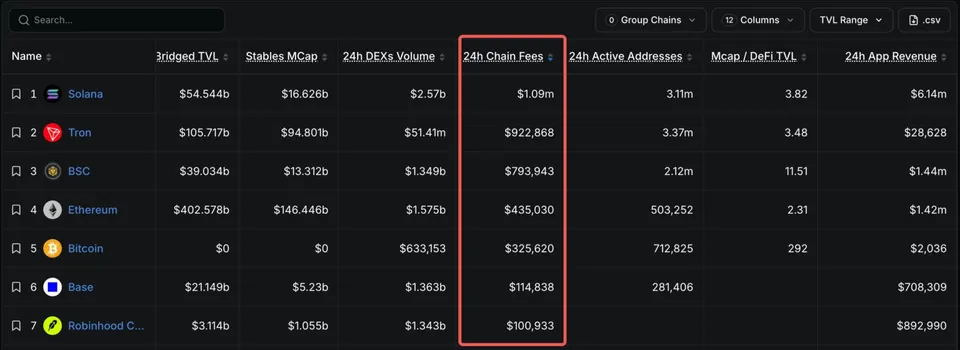
DefiLlama is a data platform that tracks fees, trading volumes and deposits across public blockchains. Its chain fees dashboard ranks networks by what users paid to transact on them, updated in real time.
Seven chains carry the fee table
At the other end, just seven blockchains cleared $100,000 in fees over the same period, according to DefiLlama: Solana with $1.09m, Tron with $922,900, BSC with $793,900, Ethereum with $435,000, Bitcoin with $325,600, Base with $114,800, and Robinhood Chain with $100,900.
Solana was the only network to break $1m. Tron and BSC followed close enough for the top three to form their own tier. Ethereum and Bitcoin, the two largest names in crypto by reputation, landed fourth and fifth. Base, the Ethereum layer-2 network, came sixth, and Robinhood Chain barely cleared the bar in seventh, sitting $900 above the $100,000 threshold.
What the numbers do and don't say
It is worth being clear about what these numbers are. Fees measure what users paid to transact, not how important a network is. The ranking reflects spending patterns on one day, not a verdict on any chain's significance.
The snapshot is also not an outlier. DefiLlama's data showed similar concentration earlier in 2026, with a small group of leading networks capturing the bulk of fee activity. Canton Network, for instance, occasionally topped revenue charts earlier in the year, a reminder that the leaderboard is competitive even if the long tail is not.
Traders and users follow the activity
For ordinary holders and users, the practical effect is choice. If you are paying to move money or trade on a chain, the fee table shows where other people are doing the same. For traders, the concentration matters because liquidity and volume tend to follow the networks where activity already sits. For the teams behind the hundreds of near-zero chains, the data poses a harder question: what would make anyone pay to use this?
Reactions on X: brutal, or expected?
Reactions on X were blunt. 8lends (@eightlends) said on X that the picture "looks brutal" and that the market needs "way more real economic activity across chains". HIGHER (@gratiattitude) said on X, "Are we surprised that these scam chains had no value transacted on them?" Ted Trading Club (@tedtradingclub) said on X that "Real usage is the moat", while pepegachad (@0xpepegachad) said on X that 514 chains were tracked with only seven "paying the rent", calling the rest "expensive testnets with logos". Cryptocards.one (@cryptocardsone) said on X that "Most chains are infrastructure waiting for users".
real talk this looks brutal
we need way more real economic activity across chains
 8lends @eightlends · · View on X
Are we surprised that these scam chains had no value transacted on them?
 HIGHER @gratiattitude · · View on X
Real usage is the moat.
 Ted Trading Club @tedtradingclub · · View on X
514 chains, 7 paying the rent. the rest are expensive testnets with logos 🤡
 pepegachad @0xpepegachad · · View on X
Most chains are infrastructure waiting for users.
 Cryptocards.one @cryptocardsone · · View on X
The wider market backdrop is steadier than the fee table. Bitcoin traded at $85,204, up 0.54% in 24 hours, and Ethereum at $2,698, up 0.53%, according to InvestIn.News market data at 12:19 UTC on 4 October 2026. Solana, the fee leader, was at $121.39, up 1.64%, while the total crypto market value stood at $2.89tn, down 2.91% over the same period.
Nothing in the DefiLlama reading names which chains earned zero, so it is not clear which projects sit in the long tail. DefiLlama updates its fees by chain rankings in real time, so the next reading will show whether the shape holds.
Questions readers ask
How many blockchains earned zero fees in 24 hours?
DefiLlama tracked 558 blockchains as of 3 October 2026, and 399 of them, or 71%, generated $0 in fee revenue over the previous 24 hours. A further 44 chains collected under $10, and 514 collected under $1,000, according to the same DefiLlama data.
Which blockchains earned the most in fees?
Only seven blockchains cleared $100,000 in 24-hour fees, according to DefiLlama. Solana led with $1.09m, followed by Tron at $922,900, BSC at $793,900, Ethereum at $435,000, Bitcoin at $325,600, Base at $114,800 and Robinhood Chain at $100,900.
Do low fees mean a blockchain is unimportant?
No. Fees measure what users paid to transact on a network over a set period, not how important that network is. The DefiLlama reading reflects spending patterns on a single day, 3 October 2026, rather than a verdict on any chain's overall significance.
Our view
The fee table is a useful filter, and it should be read as a snapshot rather than a verdict. Since 2020 the market has produced a steady stream of would-be Ethereum killers and Solana killers, and most of them never turned usage into revenue; several were hacked along the way. The chains that survived are those users trusted in both good and bad markets, and that trust shows up as fees.
In my view, the number worth watching is not 71% but the gap between the seven networks clearing $100,000 and everyone else. If that gap narrows because new chains attract real activity, the market is broadening. If it narrows because the leaders lose users, the picture is worse, not better.
Follow the latest Ethereum updates as they happen on Ethereum NewsFeeds.
What to watch: DefiLlama updates its chain fee rankings in real time, so the next daily reading will show whether the concentration holds.
Sources
Live updates on NewsFeeds:EthereumBy Ishu Aggarwal
Disclosure: Ishu Aggarwal does not own any cryptocurrency, tokens or shares in crypto companies, and is not paid by any company covered on this site, updated 6 October 2026. Our holdings and trading policy.
How this was produced: the writer drafted this piece with AI help, from the reporting and sources it names, then checked and edited it. Read our Editorial and AI policy. Spotted a mistake? See Corrections.
Not investment advice. Read the risk disclaimer.