 BTC
 ETH
 SOL
 XRP
 BNB
 DOGE
 ADA
 AVAX
 LINK
 TON
 DOT
 LTC
 TRX
 POL
 USDT
 USDC
 SUI
 HBAR
 SHIB
 BCH
 XLM
 NEAR
 APT
 ARB
Bitcoin Core discloses high-severity bug that could halt mining nodes
Bitcoin Core published details of three previously patched flaws on 10 Nov 2026, including a high-severity defect that could stop affected nodes producing valid block templates after a chain reorganisation.
Why it matters: The disclosure shows that patched software defects can still disrupt mining operations and node privacy even when they cannot compromise funds or the network's consensus.

Key points
- CVE-2025-62861 affected Bitcoin Core versions 28.0 to 28.2 and 29.0 to 29.1, and was fixed in 30.0, 29.2 and 28.3 in October 2025.
- About 9% of reachable nodes were still advertising vulnerable versions around the disclosure date.
- The two other flaws, CVE-2025-62859 and CVE-2025-62860, involved compact blocks and Tor whitelist permissions.
Bitcoin Core has disclosed three security vulnerabilities, including a high-severity bug that could halt mining nodes, after keeping the technical details confidential until the final vulnerable release line reached end-of-life. The details were published on 10 Nov 2026, though developers had patched the problems in October 2025.
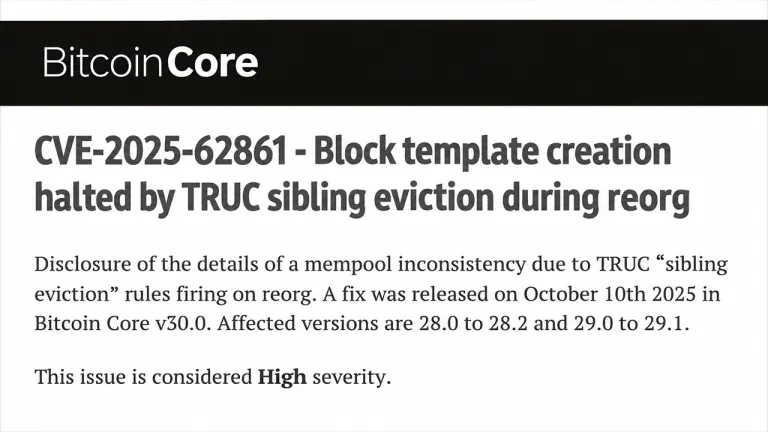
The most serious flaw, CVE-2025-62861, affected versions 28.0 to 28.2 and 29.0 to 29.1. It involved version 3 transactions, known as TRUC transactions, during blockchain reorganisations, when the software could evict transactions while keeping dependent ones. Affected mining nodes could then fail block template validation and keep hashing outdated work until restarted, potentially losing transaction fees. Researcher Niklas Goegge reported it on 26 Sept 2025, and a fix by Greg Sanders was merged on 2 Oct.
The second flaw, CVE-2025-62859, was rated medium severity and involved maliciously built compact blocks that could repeatedly delay block downloads. Eugene Siegel identified it in April 2025. The third, CVE-2025-62860, concerned inbound Tor connections inheriting trusted-peer privileges when operators whitelisted their Tor daemon address, weakening denial-of-service and privacy safeguards. Thousands of reachable mainnet nodes were potentially exposed, though default configurations were safe.
Bitcoin Core said none of the flaws allowed Bitcoin theft, unauthorised coin creation or consensus failure, and no exploitation was reported.
Live updates on NewsFeeds:MiningDesk editor: Keshav Aggarwal (accountable for this page; this summary was not edited by hand)
How this was produced: an AI model wrote this summary of Bitcoin.com News’s report, which we credit and link above. Read our Editorial and AI policy. Spotted a mistake? See Corrections.
Not investment advice. Read the risk disclaimer.