 BTC
 ETH
 SOL
 XRP
 BNB
 TON
 DOT
 LTC
 POL
 HBAR
 NEAR
 ARB
 UNI
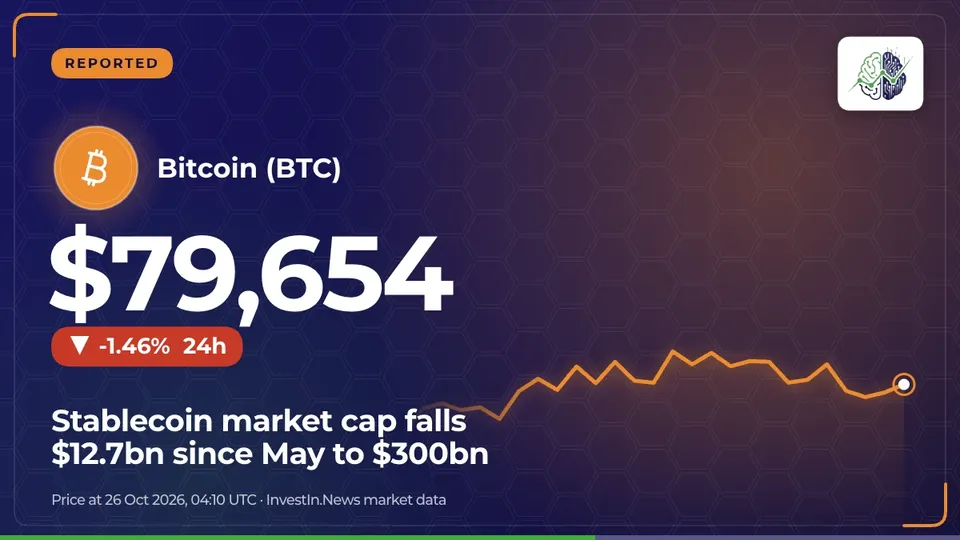
Stablecoin market cap falls $12.7bn since May to $300bn
Tether's USDT and Circle's USDC led the retreat, but tokenised Treasury products also shrank, raising questions about whether crypto's dry powder is leaving or just moving.
Why it matters: The stablecoin retreat matters because traders see these tokens as crypto's ready cash, and a shrinking supply raises questions about whether buying power is leaving the market.

Reviewed and fact-checked by Ishu Aggarwal on 26 Oct 2026
In short
- InvestIn.News said on X stablecoin market cap is down $12.7bn since 22 May to $300bn as of 25 October.
- Tether's USDT stood at $182bn, down $1.29bn in 30 days, while Circle's USDC fell $4.69bn to $71.7bn.
- Tokenised Treasury products including BlackRock's BUIDL also shrank $1.55bn, complicating the dry-powder story.
- PayPal's PYUSD and Falcon's USDf grew, showing the retreat was not uniform.
Stablecoin market cap down $12.7bn
InvestIn.News said on X on 26 October 2026 that the total stablecoin market capitalisation has fallen $12.7bn since 22 May, to $300bn as of 25 October. Tether's USDT stood at $182bn, down $1.29bn over 30 days, while Circle's USDC dropped $4.69bn to $71.7bn, according to the figures in that post, which cited CoinNess. Stablecoins are digital tokens built to hold a steady value, usually $1, and traders treat them as ready cash for buying cryptocurrencies.
Stablecoin market cap is down $12.7bn since 22 May, to $300bn as of 25 Oct.
• USDT's cap was $182bn, down $1.29bn in 30 days
• USDC's fell $4.69bn to $71.7bn
Source: CoinNess
 InvestIn.News @InvestInNews · · View on X
USDC leads the retreat
Bitcoin.com reported on 26 October that the stablecoin market had slipped to $300bn as of 25 October, down $12.7bn from 22 May, citing DefiLlama data. USDT still controlled 60.74% of the market, according to that report. USDC took the biggest hit over the month, losing $4.69bn to reach $71.7bn, while USDT fell $1.29bn to $182bn. Among the 15 largest stablecoins, USDC accounted for roughly 80% of the $5.82bn monthly drop reported by Bitcoin.com.
Why traders watch stablecoin supply
The fall matters because stablecoin supply is seen as a gauge of buying power waiting to enter crypto markets. When users mint stablecoins, circulating supply usually grows. When holders redeem tokens for fiat currency, that supply contracts and may reduce capital available to buy Bitcoin, ether or other assets. Bitcoin.com noted that stablecoin expansion accompanied the 2020 to 2021 bull market, while contraction after Terra's collapse in 2022 coincided with a long downturn.
Bitcoin near $80,000 as crypto dips
At the time of writing (06:16 UTC on 26 October 2026), Bitcoin traded at $79,897, down 0.77% in 24 hours, with a market value of $1.61tn, according to InvestIn.News market data. Total crypto market value stood at $2.64tn, down 0.62% over 24 hours. Bitcoin.com noted that Bitcoin's price near $80,000 is well below its October 2025 record near $126,000, adding to traders' questions about how much buying power remains.
Tokenised Treasuries complicate the story
Bitcoin.com cautioned that not every disappearing stablecoin has actually left the crypto market. Tokenised US Treasury products, including BlackRock's BUIDL and Ondo's USDY, also contracted from $16.2bn on 12 August to $14.7bn on 25 October, according to rwa.xyz logs cited by Bitcoin.com. Because Treasury investors might redeem positions to buy stablecoins or risk assets, the direction of that money matters more than the redemption itself. This makes aggregate stablecoin supply a blunt tool for measuring investor intentions.
The retreat was not uniform. PayPal's PYUSD added $240m over 30 days, and Falcon's USDf expanded by $511m, a 42.32% increase, according to the DefiLlama data cited by Bitcoin.com. Ethena's USDe fell $306m over the month, while World Liberty Financial's USD1 shed $445m, a 10.10% decline. Those moves suggest changing preferences within the stablecoin space rather than a simple overall exit.
For ordinary stablecoin holders, the figures do not mean USDT or USDC lost their dollar peg. They point to a slower expansion of crypto's ready cash, which traders read as possibly weaker buying demand. Whether the missing $12.7bn has left crypto, moved into tokenised Treasuries or shifted to other assets remains unclear. Bitcoin.com said exchange-level balances, issuance patterns and redemption destinations would give a fuller picture of deployable liquidity.
Timeline
- 22 May 2026: Stablecoin market cap begins a $12.73bn decline
- 12 Aug 2026: Tokenised Treasury products' combined capitalisation stands at $16.2bn
- 25 Oct 2026: Stablecoin market cap reaches $300.36bn, down $12.73bn since May
- 26 Oct 2026: Bitcoin.com reports the DefiLlama data
Questions readers ask
Why has the stablecoin market cap fallen by $12.7bn?
The total stablecoin market cap fell to $300bn as of 25 October 2026, down $12.7bn from 22 May, according to DefiLlama data cited by Bitcoin.com. Tether's USDT lost $1.29bn over 30 days, and Circle's USDC shed $4.69bn to $71.7bn.
Is the stablecoin decline a bearish signal for crypto?
Traders often see shrinking stablecoin supply as weaker buying power, but Bitcoin.com noted tokenised Treasury products also shrank, suggesting money may have rotated rather than left the market.
Which stablecoins grew despite the decline?
PayPal's PYUSD added $240m over 30 days, and Falcon's USDf expanded $511m, a 42.32% increase, according to DefiLlama data cited by Bitcoin.com.
Our view
At InvestIn.News, we think the $12.7bn fall in stablecoin market capitalisation since 22 May is not by itself proof that crypto investors are turning bearish. The decline in Tether's USDT and Circle's USDC looks like dry powder draining from the market, yet the same period saw tokenised Treasury products such as BlackRock's BUIDL and Ondo's USDY shrink by $1.55bn. That makes it hard to say whether capital exited crypto or moved into other assets.
The most plausible explanations are the ones visible in the data: holders may be waiting for the US midterm elections, shifting into safer assets, or allocating to AI rather than buying digital assets now. A breakdown of where redeemed stablecoin balances went after 25 October would sharpen the picture, particularly whether exchange stablecoin reserves rebuild once the election uncertainty passes. Until that data arrives, treating the whole contraction as a bearish liquidity signal overstates the evidence.
Follow the latest as it happens on Stablecoins NewsFeeds.
Sources
Live updates on NewsFeeds:StablecoinsBy Keshav Aggarwal
Disclosure: Keshav Aggarwal holds small amounts of crypto as long-term investments. He does not trade any asset he writes about within 24 hours of a story, and is not paid by any company covered on this site, updated 6 October 2026. Our holdings and trading policy.
How this was produced: the writer drafted this piece with AI help, from the reporting and sources it names, then checked and edited it. Read our Editorial and AI policy. Spotted a mistake? See Corrections.
Not investment advice. Read the risk disclaimer.