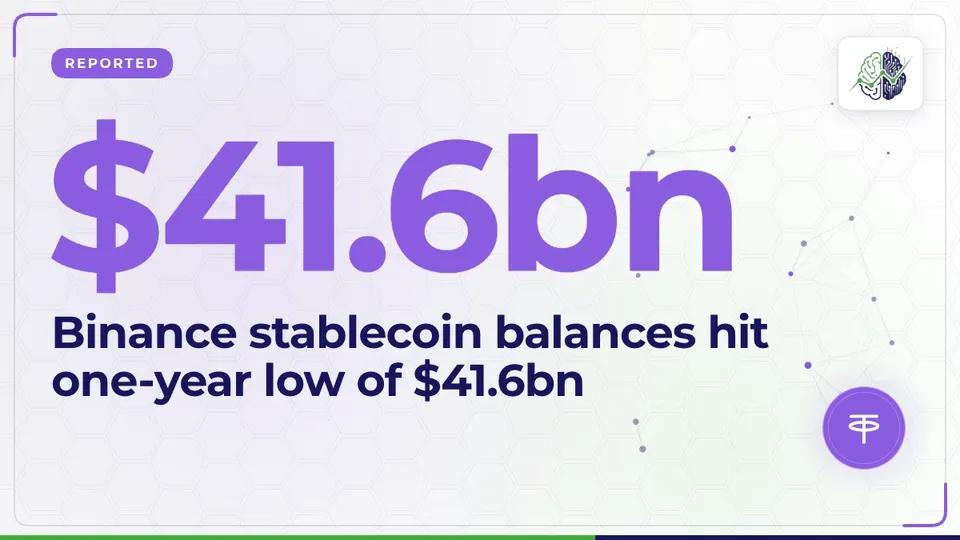
Binance stablecoin balances hit one-year low of $41.6bn
Stablecoin reserves keep falling across major crypto exchanges, with Binance at a one-year low of $41.6bn in ERC-20 balances, according to analyst Darkfost.
Why it matters: Falling stablecoin reserves on exchanges mean less money ready to buy crypto, which can make market moves weaker even when prices rise.

Reviewed and fact-checked by Ishu Aggarwal on 21 Oct 2026
In short
- Binance's stablecoin balance fell to a one-year low of $41.6bn, with $6.3bn leaving since April, analyst Darkfost says.
- USDT ERC-20 liquidity across exchanges dropped to $47.3bn, also a one-year low, according to KuCoin.
- Bybit, Coinbase Advanced and OKX have lost between $2.3bn and $2.5bn in stablecoin reserves since April, CoinPedia reports.
- Darkfost says investors may be waiting out macro worries and seeking yield elsewhere.
Stablecoin exchange balances hit one-year low
Stablecoin balances on major centralised crypto exchanges have fallen to their lowest level in a year, according to a post by crypto analyst Darkfost seen by InvestIn.News on 21 October 2026. Binance's stablecoin balance dropped to a one-year low of $41.6bn, with net outflows of $6.3bn since April, Darkfost said. CoinNess reported the same figures, and KuCoin's separate data put USDT (ERC-20) liquidity on exchanges at $47.3bn, also a one-year low. The two figures are not directly comparable: Binance's covers all stablecoins held on a single exchange, while KuCoin's covers USDT on ERC-20 across exchanges.
Why the drain has lasted for months
Why the drain has lasted for months: KuCoin said on 14 October that USDT (ERC-20) liquidity had fallen to $47.3bn, a one-year low, and that stablecoin balances on exchanges had been declining for months. Darkfost offered three possible reasons: exchanges are adjusting stablecoin supply to match investor demand, investors are reluctant to put money into crypto, and some are chasing yield on other platforms while they wait for better conditions.
At the time of writing (08:53 UTC on 21 October 2026), Arbitrum (ARB) traded at $0.189, down 0.46% in 24 hours, with a market value of $1.3 billion, according to InvestIn.News market data.
What falling stablecoin reserves mean for buyers
Falling reserves leave traders with less immediate buying power. KuCoin has warned that less stablecoin liquidity on exchanges means less firepower for a strong risk-on move. CoinPedia reported that the declines go beyond Binance: Bybit has lost $2.3bn in stablecoin reserves since April, Coinbase Advanced $2.5bn and OKX $2.4bn.
Crypto market traded higher despite the drain
While exchange stablecoin reserves have dropped, the wider crypto market traded higher on 21 October. Bitcoin (BTC) traded at $83,151, up 2.22% in 24 hours, with a market value of $1.67tn, and total crypto market value stood at $2.8tn, according to InvestIn.News market data at 08:53 UTC.
Traders ask why reserves are falling now
Northern Tape (@NorthernTape) said on X that the numbers fit the aggregate: total stablecoin market capitalisation was about $304bn on DefiLlama, down 0.85% on the week, and that reserves falling faster than supply means 'dry powder isn't just shrinking, it's sitting further from the order books'. Edwards (@Edwards227192) asked on X why reserves are dropping so sharply now. Seeker (@seekertilldawn) said on X that large ERC-20 stablecoin transfers could be an early clue before the monthly reserve chart turns.
🗞️ Stablecoin Reserves Are Falling Across Exchanges, With Binance at a 1-Year Low
Stablecoin reserves on Binance have just hit their lowest level of the year.
With $41.6B of stablecoins (ERC-20) in reserve, Binance is back to its early October 2025 level. Since April 2026,… pic.twitter.com/F7TjLFkCyE
 Darkfost @Darkfost_Coc · · View on X
Fits the aggregate too: total stablecoin cap ~$303.5B on DefiLlama, −0.85% on the week and about flat over 30 days. Reserves falling faster than supply means the dry powder isn't just shrinking, it's sitting further from the order books.
 Northern Tape @NorthernTape · · View on X
why are reserves dropping so sharply now?
 Edwards @Edwards227192 · · View on X
Before the monthly reserve chart turns, the first clue may be where large ERC-20 stablecoin transfers start routing. https://t.co/68e6rE62S4 explores possible capital routes with Jev and lets you inspect recent EVM transactions behind the idea.
 Seeker @seekertilldawn · · View on X
Darkfost said the shortage of fresh liquidity is worsening the market downturn, and that things would only change once liquidity came back to exchanges. CoinPedia struck a similar note, arguing that a lasting revival in stablecoin deposits would point to investors returning and to better liquidity in crypto markets.
Questions readers ask
What is happening to stablecoin balances on crypto exchanges?
Stablecoin balances on major centralised exchanges have fallen to their lowest level in a year. Binance's stablecoin balance dropped to $41.6bn, with $6.3bn in net outflows since April 2026, according to analyst Darkfost.
Why are stablecoin reserves falling?
Analyst Darkfost said exchanges are adjusting stablecoin supply to match demand, investors are hesitant to invest in crypto, and some are seeking yield elsewhere while waiting for better conditions.
What does falling stablecoin liquidity mean for crypto buyers?
Less stablecoin liquidity on exchanges reduces immediate buying power, making a strong risk-on move less likely, according to KuCoin and CoinPedia.
Which exchanges have seen the biggest stablecoin declines?
Binance, Bybit, Coinbase Advanced and OKX have all declined since April, with Bybit losing $2.3bn, Coinbase Advanced $2.5bn and OKX $2.4bn, CoinPedia reported.
Our view
At InvestIn.News, we think this is not a temporary dip in exchange stablecoin reserves, but a sign of deeper risk aversion. The drain comes as investors weigh war, rising oil prices and renewed inflation fears, while much of the available cash is being pulled toward artificial intelligence rather than crypto. The result is a market where fewer stablecoins are parked on trading venues, leaving less dry powder for any recovery.
The data support this caution. Binance's stablecoin balance has fallen to $41.6bn, a one-year low, and KuCoin puts exchange-wide USDT liquidity at $47.3bn. If investors were simply waiting for a short-term entry point, we would expect the trend to stabilise quickly. Instead, the outflows have persisted for months.
A sustained return of stablecoin inflows would be the clearest signal that risk appetite is returning. Until then, lighter exchange liquidity suggests that any rebound will start from a lower base.
Follow the latest Stablecoins updates as they happen on Stablecoins NewsFeeds.
Sources
- KuCoin: Exchange Stablecoins Ratio Hits One-Year High as USDT Reserves Fall to One-Year Low | KuCoin - Exchange Stablecoins Ratio Hits One-Year High as USDT Reserves Fall to One-Year Low
- Coinpedia: Binance Stablecoin Reserves Hit One-Year Low at $41.6 Billion
- CoinNess: Darkfost says exchange stablecoin balances hit one-year low as liquidity drains
- Darkfost (@Darkfost_Coc): Post
- Northern Tape (@NorthernTape): Post
- Edwards (@Edwards227192): Post
- Seeker (@seekertilldawn): Post
- KuCoin: Stablecoin flows to exchanges remain negative. Exchange bal | KuCoin
- KuCoin: Stablecoin flows on exchanges remain NEGATIVE. 📉 🔹 Exchang | KuCoin
- InvestIn.News market data
Live updates on NewsFeeds:StablecoinsBy Keshav Aggarwal
Disclosure: Keshav Aggarwal holds small amounts of crypto as long-term investments. He does not trade any asset he writes about within 24 hours of a story, and is not paid by any company covered on this site, updated 6 October 2026. Our holdings and trading policy.
How this was produced: the writer drafted this piece with AI help, from the reporting and sources it names, then checked and edited it. Read our Editorial and AI policy. Spotted a mistake? See Corrections.
Not investment advice. Read the risk disclaimer.