Study finds waiting for a 30% bitcoin dip often costs more
An analysis of 216 bitcoin highs found that waiting for a 30% pullback led to a higher purchase price in 61% of cases, according to Adam Livingston of Strive Inc.
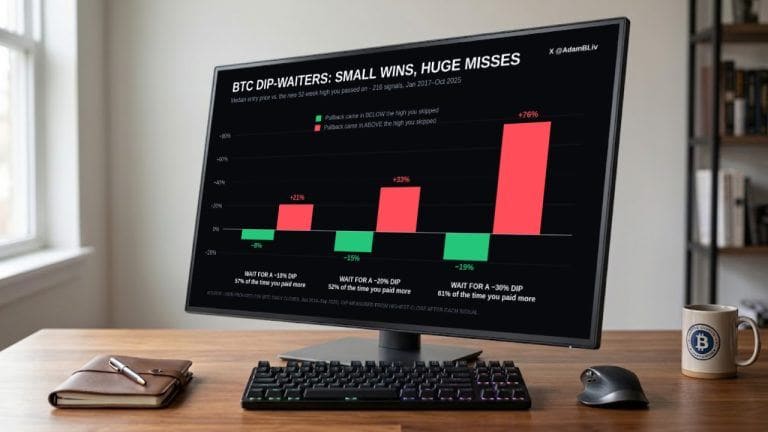
Key points
- Adam Livingston, vice president of investments at Strive Inc. (Nasdaq: ASST), published the analysis on X on Sept. 27.
- The test started at each of 216 new 52-week closing highs from January 2017 through October 2025.
- A 30% decline took a median 134 days to arrive, and up to 881 days.
- When waiting worked, the median entry was 19% below the earlier high; when it failed, the median entry was 76% above it.
- Smaller dips also often failed: a 10% drop arrived after a median 14 days but produced a higher entry in 57% of cases.
Waiting for a 30% bitcoin dip backfired in most of the cases Adam Livingston examined, according to his analysis of bitcoin dip buying. Livingston, vice president of investments at the bitcoin treasury company Strive Inc. (Nasdaq: ASST), shared the work in a Sept. 27 post on X. His test begins at each of 216 new 52-week closing highs from January 2017 through October 2025, then models waiting for a pullback before buying.
The results show that in 61% of cases the modelled purchase cost more than buying at the earlier high. The reason is where a decline starts. Bitcoin can climb well beyond an earlier high before falling 30% from a later peak, so the size of the fall does not show whether the price has returned to the level a buyer first rejected.
The waiting times were long. A 30% decline took a median 134 days to arrive, and in the slowest case 881 days. Livingston illustrated the effect with an August 2020 starting price of $12,300. Under his 30% pullback rule, the modelled purchase came at $43,580, about 254% higher than the price he would have skipped.
A test of 216 highs
Smaller declines followed a similar pattern, though buyers waited less. A 10% dip arrived after a median 14 days, yet the modelled entry exceeded the skipped price in 57% of cases. A 20% drop took a median 44 days and produced a higher entry in 52% of cases.
The outcomes were widely split. When the 30% rule secured a lower price, the median entry was 19% below the original high. When it produced a higher price, the median entry was 76% above that high. Livingston's figures describe results inside his historical test, not gains or losses from real trades.
The calculation relies on daily closing prices and a particular rule for measuring a dip from a later high. Closing prices can vary by data source and time of day; CF Benchmarks, for instance, derives a daily bitcoin reference price from trades across several exchanges at the New York market close. Livingston's 216 signals may also include nearby highs from the same rally, so the percentages should not be read as 216 separate market cycles.
Smaller dips also failed
Waiting has sometimes paid off. Bitcoin set a record above $126,000 in October 2025 before a prolonged decline, and by June 30 it had fallen below $58,000, less than half that peak. A buyer who waited from the peak could have found a lower price. On Sept. 26, bitcoin was still about 33% below its October record, trading near $84,162 after pulling back from a September high of about $87,374, though it had rebounded roughly 46% from its June low of about $57,735.