 BTC
 ETH
 SOL
 XRP
 BNB
 TON
 DOT
 LTC
 POL
 HBAR
 NEAR
 ARB
 UNI
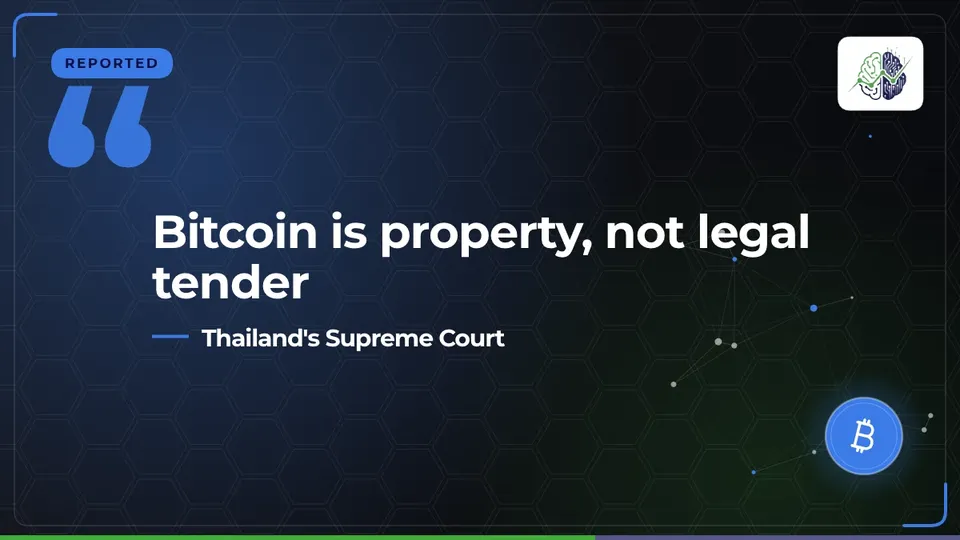
Thailand's Supreme Court says Bitcoin is property, not legal tender
The full-bench ruling upheld a 10-year sentence in a 2022 Koh Samui robbery, marking Bitcoin as property under criminal law. It does not make Bitcoin legal tender.
Why it matters: Thai bitcoin holders now have a clearer legal route to claim stolen bitcoin as property, though the ruling stops short of making it money.

Reviewed and fact-checked by Ishu Aggarwal on 28 Oct 2026
In short
- Thailand's Supreme Court ruled on 28 October 2026 that Bitcoin is property under criminal law, in judgment No. 4929/2569.
- The ruling upheld a 10-year sentence in a 2022 Koh Samui robbery where 2.480801 BTC was forced from a victim.
- The court said Bitcoin has market value and can be possessed, but it is not legal tender.
- At 16:22 UTC, Bitcoin traded at $80,386, down 0.28% in 24 hours, with a $1.62tn market value.
In judgment No. 4929/2569, issued on 28 October 2026, Thailand's Supreme Court held that Bitcoin qualifies as property for the purposes of the country's criminal law. The decision arose from a robbery on Koh Samui in September 2022, in which a victim was made to hand over about 2.48 BTC, then valued at roughly $50,000. The court left the defendant's 10-year prison term standing, Crypto Briefing and TradingView reported.
The judgment, reviewed by InvestIn.News, treats Bitcoin as property, not as legal tender. At the time of writing (16:22 UTC on 28 October 2026), Bitcoin traded at $80,386, down 0.28% in 24 hours, with a market value of $1.62tn, according to InvestIn.News market data.
The Koh Samui robbery behind the ruling
According to TradingView, the case dates to September 2022 on Koh Samui, where five foreign men attacked and threatened a tourist and made the victim convert $50,000 into 2.480801 BTC before transferring it. Crypto Briefing reported that the Bitcoin was worth about $50,000 at the time and has since risen more than fourfold to about $200,000. On our calculation, at the $80,386 price cited in this story, the stolen 2.480801 BTC is now worth about $199,400.
Why the court called Bitcoin property
ChainCatcher reported that the ruling drew on Sections 137 and 138 of the Thai civil and commercial code, along with the 2018 Digital Asset Business Emergency Decree, which treats cryptocurrency as electronic data for use as a medium of exchange. BlockBeats reported that the full bench found Bitcoin to carry market value, to be buyable and sellable, and to be convertible into cash where a buyer exists. ChainCatcher also noted the court's citation of a Bank of Thailand letter, which said cryptocurrencies are not legal tender for settling debts but do hold market trading value.
What it means for Thai Bitcoin holders
For a Thai holder who loses Bitcoin through theft or robbery, the ruling offers a clearer path for criminal charges and compensation. It also means courts can treat Bitcoin as property to be returned, rather than worthless data. The decision does not make Thai baht any less the country's only legal tender, and it does not force any shop or bank to accept Bitcoin, KuCoin reported.
How the crypto community reacted
Crypto Attano Natho (@Crypto_A_Natho) said on X that, as a Thai, the ruling means property tax or unrealised capital gains at worst. Bitty Coinware (@BittyCoinware) said on X that courts are catching up with what the code settled in 2009, and called it good news for Thai holders. Lily Nguyen (@NgocNguyen21127) asked on X whether recognising Bitcoin as property protects holders in court disputes or merely sets up taxation. SwedishTechie (@SwedishTechie) said on X that big players are involved. xabz (@xabzxbt) said game theory indeed.
game theory indeed
 xabz @xabzxbt · · View on X
Damn they big players wtf
 SwedishTechie @SwedishTechie · · View on X
As a Thai, I can tell you, this only means they want to put property tax on it at best or unrealized capital gain at worst.
 Crypto Attano Natho @Crypto_A_Natho · · View on X
Funny how courts keep catching up to what the code settled back in 2009. Good news for anyone in Thailand holding their own keys 👍🏻
 Bitty Coinware @BittyCoinware · · View on X
Does recognizing it as property actually protect holders in court disputes, or just set up taxation?
 Lily Nguyen @NgocNguyen21127 · · View on X
What the ruling does not change
Pete Rizzo, a former Bitcoin Magazine editor, said on X that Thailand's Supreme Court had officially recognised Bitcoin as legal property. The court's own language, as reported by BlockBeats and KuCoin, makes clear that Bitcoin is protected property under criminal law, not legal tender. Thai baht remains the only legal tender in Thailand.
Questions readers ask
Is Bitcoin legal in Thailand?
Thailand's Supreme Court ruled on 28 October 2026 that Bitcoin is property under criminal law, but it is not legal tender. Thai baht remains the only legal tender. Bitcoin has market value, can be possessed and transferred, and is protected in theft and robbery cases.
What was the Supreme Court's decision on Bitcoin?
In judgment No. 4929/2569, Thailand's Supreme Court said Bitcoin has market value, can be bought and sold, and can be exchanged for cash when there is a buyer. It upheld a 10-year sentence in a 2022 Koh Samui robbery and ordered return of 2.480801 BTC or compensation.
Does the ruling make Bitcoin legal tender in Thailand?
No. The Supreme Court ruling recognises Bitcoin as property under criminal law only. It does not give Bitcoin the status of Thai baht, and it does not require shops or banks to accept Bitcoin as payment.
Our view
At InvestIn.News, we think this ruling is a practical step forward for Bitcoin in Thailand, but it is not the moment Bitcoin becomes money. The court did not declare Bitcoin legal tender; it only confirmed that a stolen asset with market value can be returned or compensated under criminal law. That is a meaningful protection for robbery victims and holders, and it matches how many courts have treated digital assets as property rather than currency. It does not, by itself, settle tax questions. Thai users are right to ask whether property classification leads to property tax or capital gains rules. A formal statement from the Bank of Thailand or the Revenue Department, or new tax guidance, would confirm how far the property label reaches. Until then, the ruling protects Bitcoin owners in criminal disputes without changing its monetary status.
Follow the latest on Regulation NewsFeeds for short updates as the news breaks.
Sources
- Crypto Briefing: Thailand’s Supreme Court rules Bitcoin qualifies as property in robbery case
- BlockBeats: Thailand's Supreme Court has officially ruled Bitcoin as "property" in the legal sense.
- ChainCatcher: The Supreme Court of Thailand ruled that Bitc...
- TradingView: Thailand Supreme Court Ruling Gives Bitcoin Legal Property Status in Robbery Case
- KuCoin: Thailand Supreme Court Recognizes Bitcoin as Legal Property in Robbery Case | KuCoin
- xabz (@xabzxbt): Post
- SwedishTechie (@SwedishTechie): Post
- Crypto Attano Natho (@Crypto_A_Natho): Post
- Bitty Coinware (@BittyCoinware): Post
- Lily Nguyen (@NgocNguyen21127): Post
- Pluang: Thailand's Supreme Court rules Bitcoin is prope... | Pluang
- InvestIn.News market data
Live updates on NewsFeeds:BitcoinRegulationBy Keshav Aggarwal
Disclosure: Keshav Aggarwal holds small amounts of crypto as long-term investments. He does not trade any asset he writes about within 24 hours of a story, and is not paid by any company covered on this site, updated 6 October 2026. Our holdings and trading policy.
How this was produced: the writer drafted this piece with AI help, from the reporting and sources it names, then checked and edited it. Read our Editorial and AI policy. Spotted a mistake? See Corrections.
Not investment advice. Read the risk disclaimer.