Bitcoin logs best weekly close since January, then slips 1.5%
Bitcoin closed the week at $84,467, its highest weekly finish in eight months, before falling 1.5% to near $83,000 on Monday as traders weighed the $79,500 and $87,000 levels.
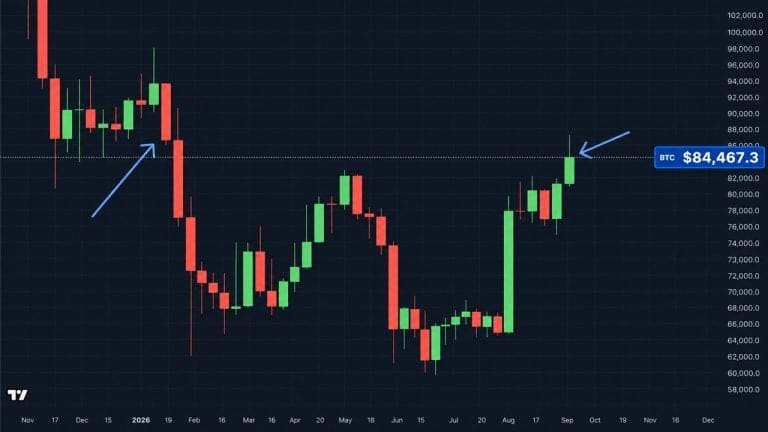
Key points
- Bitcoin's weekly close of $84,467 on Sept. 27 was its highest since the last week of January.
- The week starting Sept. 21 opened at $81,178 and printed a high of $87,395, capping a quarter with roughly 44% gains.
- US spot bitcoin ETFs drew about $2.4 billion last week, their strongest week since October 2025, per Scott Melker.
- Analyst Benjamin Cowen noted BTC usually runs 20% to 30% after reclaiming the 50-week average, but this move was muted.
- The Federal Reserve raised rates on Sept. 16, its first hike since July 2023, with the 10-year Treasury at 5.17%.
Bitcoin's weekly close of $84,467 on Sept. 27 was its best weekly finish since January, Bitcoin.com News reports, before the price gave back 1.5% and traded near $83,000 on Monday. The week starting Sept. 21 opened at $81,178 and closed at $84,467, a level no weekly close had topped since the last week of January. That earlier peak was followed by a slide that dragged bitcoin toward $60,000 in early February.
The same week printed a high of $87,395, prices not seen in more than eight months, as trader Martini Guy noted. It also capped a quarter in which bitcoin gained about 44%, its second-best third quarter on record. The close sat above May's intraday high of $82,850 and marked the second straight weekly close above the 50-week moving average, a gauge that averages the last 50 weekly closes and sits near $78,200.
Analyst Crypto Rover took what Bitcoin.com News called the loudest victory lap, saying bitcoin had closed its first weekly candle above the May highs and its second above the 50-week moving average, and concluding the bear market was over. BTC advocate Scott Melker noted that US spot bitcoin exchange-traded funds drew roughly $2.4 billion last week, their strongest week since October 2025. Bitcoin.com News tracked the inflow streak as it stretched to seven days and $2.98 billion.
Best close since January
Attention also turned to the calendar. Coinglass greeted Sunday night with a short post reading "UPtober is on the way," and Binance's monthly candles show October finishing green in six of the last eight years, including gains of 39.9% in 2021 and 28.5% in 2023. The two misses, in 2018 and 2025, were both losses of about 3.9%.
Analyst Benjamin Cowen was not entirely convinced. He conceded the technicals were promising and said the burden of proof remained with the bears, but he questioned the size of the move. Usually, after passing the 50-week average, as in 2019 and 2023, bitcoin runs 20% to 30% within one to two weeks. This time the move was much more muted, which he attributed to fears over seasonality and rising yields.
Those yields are tangible. The Federal Reserve raised rates on Sept. 16 for the first time since July 2023, and the 10-year Treasury closed Friday at 5.17%, near levels last seen in 2007. Pundit Emreislek went further, saying bitcoin appeared to have completed a bearish retest of the $85,000 to $93,000 zone, and that unless prices climb back into it, the plan is to add hedge shorts and move toward a market-neutral position.
Bulls point to ETF inflows
Within hours of the close, bitcoin was trading near $83,000, down 1.5% on the day, and touched $82,705, just below the May high the bulls had celebrated clearing. Cowen had written that he expected bitcoin either to have accepted back below that level or to be much higher by now. Bitcoin.com News also noted that buyers who waited for a 30% dip paid more in 61% of tested cases.