Eight AI chatbots predict bitcoin closing 2026 between $95,000 and $115,000
Bitcoin.com News asked eight leading AI chatbots where bitcoin will end 2026, and all forecast gains, with targets ranging from $95,000 to $115,000.
Key points
- Bitcoin traded just below $85,000, up 26% over six months, with a 24.95% gain in August and 7.03% so far in September, per Coinglass data.
- The eight models queried were Gemini Pro 3.1, Kimi K3, Claude Opus 5.5, Grok 4.7, Mistral Medium 3.5, Inflection-2, Deepthink and ChatGPT Astra.
- Forecasts ranged from ChatGPT Astra's $95,000 to Pi AI's $115,000, with Gemini at $96,500 and Deepthink at $112,000.
- Typesafe AI's Jev picked Kimi's $96,000 target as the best fit, rating the more conservative forecasts higher.
- The prompt cited ETF demand, Strategy's renewed BTC purchases, US-Iran tensions and the T-500 milestone, 64 days away.
Bitcoin.com News asked eight leading AI chatbots to forecast bitcoin's closing price on Dec. 31, 2026, and every model expected gains. The predictions ranged from $95,000 to $115,000, against a spot price hovering just below $85,000 at the time of writing. The outlet said the exercise offered a glimpse into how AI interprets the market, and that the models disagreed on what comes next.
The article noted that August and September have historically been weak months for bitcoin, but the cryptocurrency flipped that pattern this year. According to Coinglass historical return data cited by the outlet, bitcoin gained 24.95% in August and had climbed 7.03% as of Sept. 26. Institutional demand has returned, with exchange-traded fund inflows supporting the price, while proponents, prediction market bettors and Wall Street appear increasingly bullish.
The chatbots queried were Google's Gemini Pro 3.1, Kimi AI's Kimi K3, Anthropic's Claude Opus 5.5 (High Intelligence), xAI's Grok 4.7, Mistral Medium 3.5, Pi AI's Inflection-2, Deepseek's Deepthink and OpenAI's ChatGPT Astra. Each received the same short prompt, which stated that bitcoin was trading just below $85,000 after a 26% six-month gain, that ETF demand had strengthened, that Strategy had resumed BTC purchases, that the US-Iran conflict continued to unsettle markets, and that bitcoin stood 64 days from T-500, a milestone marking the 500-day countdown to its fifth halving.
Eight models give forecasts
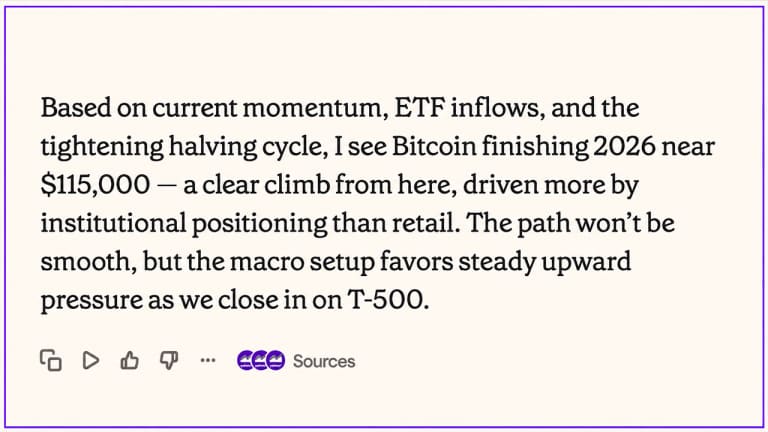
The published answers varied. Gemini Pro 3.1 forecast $96,500, arguing that ETF absorption and corporate treasury accumulation are draining liquid exchange reserves ahead of the pre-halving transition. ChatGPT Astra gave $95,000, a base case implying roughly 12% upside, and said it weighted demand flows more heavily than T-500 because the milestone does not reduce issuance, with the next supply cut expected in 2028. Deepthink predicted $112,000, citing ETF inflows and treasury purchases while warning that US-Iran tensions limit upside. Pi AI's Inflection-2 forecast $115,000, the highest target, calling the path uneven but favouring steady upward pressure.
The outlet observed that the models differed less on direction than on which forces would carry the most weight. Gemini, Kimi, Claude and ChatGPT occupied the more cautious end, Grok held the middle ground, and Mistral, Pi and Deepseek staked out the bullish territory. Bitcoin.com News suggested this divergence may reflect differing underlying assumptions rather than access to fundamentally different information.
The outlet then turned to Jev, a model from Typesafe AI. It described Jev as a formal verification toolkit for AI-generated code that uses type theory and proof assistants to establish mathematically whether large language model outputs satisfy predefined specifications, rather than relying on probabilistic testing alone. Jev was given two tasks: identify the forecast most consistent with the information provided, and rate each prediction on a four-point scale from poor fit to strong fit.
Where the targets landed
Jev selected Kimi's $96,000 forecast and generally favoured the more conservative targets. According to its output, Kimi, ChatGPT, Claude and Gemini received reasonable-fit assessments, while Grok earned a weaker rating, followed by less favourable assessments for the higher targets from Deepseek, Pi and Mistral. The outlet noted that these scores reflect how closely Jev considered each projection aligned with the supplied information and timeframe, that they do not establish what bitcoin will ultimately be worth, and that Jev provided no written explanation for its selections.