 BTC
 ETH
 SOL
 XRP
 BNB
 TON
 DOT
 LTC
 POL
 HBAR
 NEAR
 ARB
 UNI
Grayscale says token inflation can erode crypto holder returns
Grayscale research chief Zach Pandl has set out an earnings-based framework that weighs protocol income and payouts against market value and new token supply.
Why it matters: Grayscale's framework gives investors a way to judge whether buybacks and staking rewards actually reach holders once new token issuance is taken into account.

Key points
- Pandl's framework was published on 21 October and compares earnings and distributions with market capitalisation.
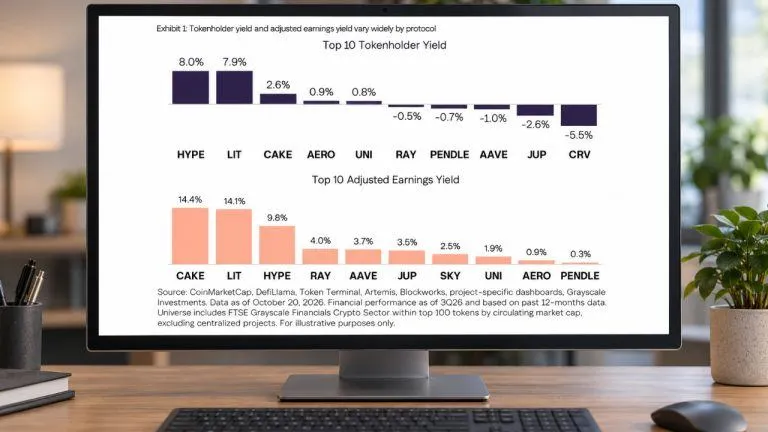
- Tokenholder yield subtracts issuance from staking rewards and buybacks, then divides by circulating market cap.
Grayscale says token inflation can erode the rewards crypto holders receive, even when the applications they hold generate real income. Zach Pandl, the digital asset manager's head of research, set out the argument in an earnings-based valuation framework published on 21 October, according to Bitcoin.com News.
Under the approach, trading, lending and other onchain financial activity produce fees, and payments to liquidity providers and lenders count as costs. What remains is earnings that can be compared across protocols. Pandl said crypto valuations "don't have to rely on narratives alone".
The framework uses two measures. Adjusted earnings yield divides total earnings by the same market value, then subtracts supply inflation. Grayscale treats buybacks as reducing circulating supply and burns as reducing total supply.
Its charts cover tokens in the FTSE Grayscale Financials Crypto Sector ranked in the top 100 by market cap, excluding centralised projects. Bitcoin, treated as a digital commodity, is valued separately as digital gold.
Live updates on NewsFeeds:MacroBitcoinDesk editor: Keshav Aggarwal (accountable for this page; this summary was not edited by hand)
How this was produced: an AI model wrote this summary of Bitcoin.com News’s report, which we credit and link above. Read our Editorial and AI policy. Spotted a mistake? See Corrections.
Not investment advice. Read the risk disclaimer.