Bitcoin and Nasdaq futures slip as Trump keeps Iran strike option open
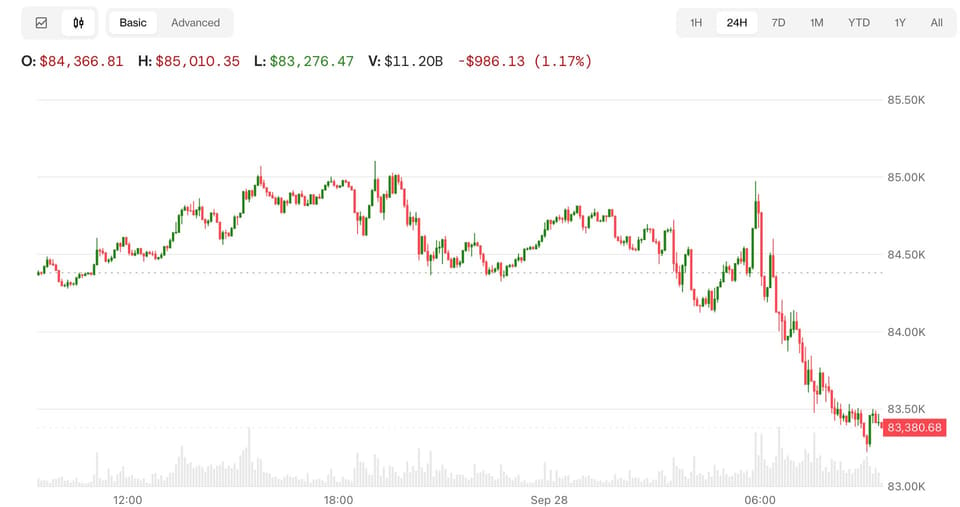
Bitcoin fell 1.3% to about $83,324 and Nasdaq futures dropped 0.7% after President Trump declined to rule out further strikes on Iran before the midterms, while oil prices rose.
Key points
- Bitcoin was down 1.3% at $83,324 at 03:30 UTC, with ether, XRP and solana posting similar losses.
- Nasdaq futures traded 0.7% lower, and WTI crude rose nearly 1% to $93.28, with Brent also higher.
- Trump said he expected the war with Iran to end soon but would not rule out more strikes before the November midterms.
- Iran proposed reopening the Strait of Hormuz for seven days and pausing fighting; Trump rejected the offer.
- The 10-year Treasury yield has climbed 127 basis points to 5.20%, its highest since 2007, on inflation and rate-hike concerns.
Bitcoin and Nasdaq futures started the week lower after President Donald Trump left open the possibility of renewed U.S. strikes on Iran before the early November midterm elections, CoinDesk reports. At 03:30 UTC, bitcoin was down 1.3% at $83,324, while ether, XRP and solana recorded similar losses. Futures tied to the tech-heavy Nasdaq index traded 0.7% lower.
Oil prices rose on both sides of the Atlantic, adding to market uncertainty. Futures linked to WTI crude climbed nearly 1% to $93.28, with Brent posting comparable gains. Crude strength and geopolitical risk are feeding into inflation worries that have weighed on markets since the war began in early March.
Trump said on Sunday that he expected the war with Iran to end very soon, but he declined to rule out further military action before the midterms. Asked whether strikes could resume, he said it was possible but that he did not want to say so, according to Fox News. He added that the United States would win through military and economic pressure, and stressed on Truth Social that Iran cannot have a nuclear weapon.
Crypto and futures slip
Iran's Foreign Minister Abbas Araghchi said his country is fully prepared for a renewed conflict and warned it could withstand even a potential doomsday war. At the United Nations General Assembly, Iran proposed an agreement to reopen the Strait of Hormuz, a major oil chokepoint disrupted by the war, for a seven-day period alongside a pause in fighting, followed by broader negotiations. Trump rejected the proposal, saying Iran was seeking a deal because it was under heavy pressure.
The lingering uncertainty has stoked inflation fears and lifted Treasury yields. The 10-year yield has risen by 127 basis points to 5.20%, the highest since 2007, amid inflation concerns, bets on Federal Reserve rate hikes and debt worries. Bitcoin fell early in the year but has rebounded strongly in the third quarter, gaining 42% over three months and outperforming major assets including Nasdaq and gold.
Analysts are watching incoming data for clues on the next move. Vikram Subburaj, chief executive of India-based exchange Giottus, said in an email that the 83,800 to 84,000 zone is important near-term support, while 85,000 to 85,800 is immediate resistance, and that it would be prudent to avoid chasing the rally at current levels. He added that limited leverage and staggered entries can help manage volatility while the market responds to ETF flows, Treasury yields and U.S. inflation data.
Iran talks and oil
U.S. PCE inflation, ISM manufacturing and nonfarm payrolls are due this week and could influence Fed rate-hike bets and the broader market. For crypto traders, the combination of oil-driven inflation risk, a 5.20% 10-year yield and upcoming economic releases leaves bitcoin's recent quarterly outperformance facing a fresh test.